WHAT
REMAINS?
What survives
the noise?
New music and new tools keep appearing. But there are things people keep coming back to, no matter how much time passes. People, instruments, places, a single record. This inaugural issue looks for that ‘reason to return.’
Choosing who would open the inaugural issue came down to one standard: someone whose name went unrecognized, yet who remained anyway. Jamerson played on hundreds of songs without a single line of credit. And still, the notes he played are here today. There was no more accurate first case for the question WHAT REMAINS.
Five ways
to remain.
James Jamerson
The moment a single note choice becomes a musical language beyond the player.
The Precision
What did a design that has survived more than 70 years actually solve?
Why This Instrument?
An instrument is a thing that makes sound, and also a thing that shapes a player’s habits.
Hitsville U.S.A.
Music history isn’t built from songs alone. The room a song was made in matters too.
One Record
How to listen to one record five times. Not knowing more — hearing more.
Practice — Back to the 1960's. Like Motown.
직접 연주하고, 무료 샘플로 연습해 보세요.
Things We Keep
An instrument you never sell, a record you play again, a place you remember for years. A small list of what remains.
James Jamerson:
The Notes Between the Notes
James Jamerson's greatness wasn't about how loud the bass could be heard. He changed how much work the bass could do inside a song.

Motown was a record label Berry Gordy founded in Detroit in 1959. As a Black-owned label, it dominated the mainstream pop charts in a way rare for its time, producing dozens of Billboard number-one songs. At the center of what's called the 'Motown Sound' was the rhythm section — a vocal laid over a frame the drums, bass, guitar, and keys had already built. Jamerson was the heart of that rhythm section.
James Lee Jamerson was born in 1936 in Edisto Island, South Carolina, and raised in Detroit. He started on upright bass before moving to electric bass in the late 1950s, and joined Motown's session scene around 1959. At the time, the electric bass was still a young instrument — barely a decade had passed since Fender introduced the Precision Bass in 1951. But Jamerson didn't treat the new instrument as a convenient stand-in for the upright. He turned it into a language of its own.
The Rock & Roll Hall of Fame credits him with playing by “instinct,” a sideman who nonetheless pulled the bass to the front of the song. That's part of why he was inducted in the Musical Excellence category in 2000. His name appeared in small print on the credits, but the lines he left changed how songs move. Marvin Gaye & Tammi Terrell's “Ain't No Mountain High Enough,” The Temptations' “My Girl,” Stevie Wonder's early hits, and “What's Going On” — his hands are underneath much of what we now remember as the Motown sound.
OF FAME
#1 HITS
#1 HITS
#1 BASSIST
Explaining what made Jamerson special only as ‘playing complicated lines’ misses the point. His lines would follow the melody, then push the kick, fill a gap left by the vocal, and open the next bar before it arrived. That complexity wasn't decoration — it came out of his relationship to the other parts. It's also well known that he played mainly with one finger of his right hand (‘The Hook’). Rather than picking fast with two fingers, he built groove from the weight and timing of a single finger.
His gear was simple too. Mostly a 1962 Fender Precision Bass strung with La Bella flatwounds, with a foam mute near the bridge to cut overtones and produce a thick, short attack. The amp was an Ampeg B-15. An unflashy combination that stayed the benchmark for ‘that sound’ for decades.
Motown's session environment matters too. According to Motown Museum records, Jamerson was a core member who led early Motown sessions alongside Benny Benjamin (drums), Robert White (guitar), and Joe Hunter (piano). Even the name we now use, ‘Funk Brothers,’ is closer to a label applied later. They're remembered as one legendary band, but in practice they were a fluid group of players moving between sessions. They worked at a pace of multiple songs a day, cutting the master take after just one or two run-throughs.
This is where the question WHAT REMAINS opens up. What remains isn't a handful of specific basslines. It's an attitude — listening to the whole and finding your place in it. Deciding which notes to play matters as much as deciding which notes to leave out. And waiting until that judgment meets the movement of the other players.
Countless players have named Jamerson as their reference point on bass. Paul McCartney, without hesitation, called him the single biggest influence on his own bass playing. The Who's John Entwistle, Led Zeppelin's John Paul Jones, Rush's Geddy Lee, Red Hot Chili Peppers' Flea — his name comes up across every genre.
So the best way to re-hear Jamerson isn't to ‘just follow the bass.’ On the first listen, take in the whole song. On the second, listen for where the drums and bass touch. On the third, listen for how the bass supports the vocal. A familiar song opens up into a different structure.
The recording story behind the “What's Going On” title track shows his instinct in a vivid way. According to Guitar World and recollections from players at the time, when Marvin Gaye found Jamerson at a bar and brought him to the studio, he could barely stand. In the end, he lay down on the studio floor and played that famous bassline. A line most players can barely nail standing up, he left behind lying down.
LISTENING NOTE — Listen to the whole song first, and from the second listen on, follow not just ‘what’ the bass played but ‘why’ it played that in that moment. Recommended tracks: “Ain't No Mountain High Enough” (isolated), “What's Going On,” “My Girl.”
IT SHAPES HOW THE SONG MOVES FORWARD.
The
Precision
That an instrument designed in 1951 still exists 75 years later may not be simple nostalgia — it may mean the problem that design solved is still valid.
This was the very design Jamerson held in his hands — a 1962 Fender Precision Bass. We've already seen what he did with that instrument. Now we look at what the instrument itself was.
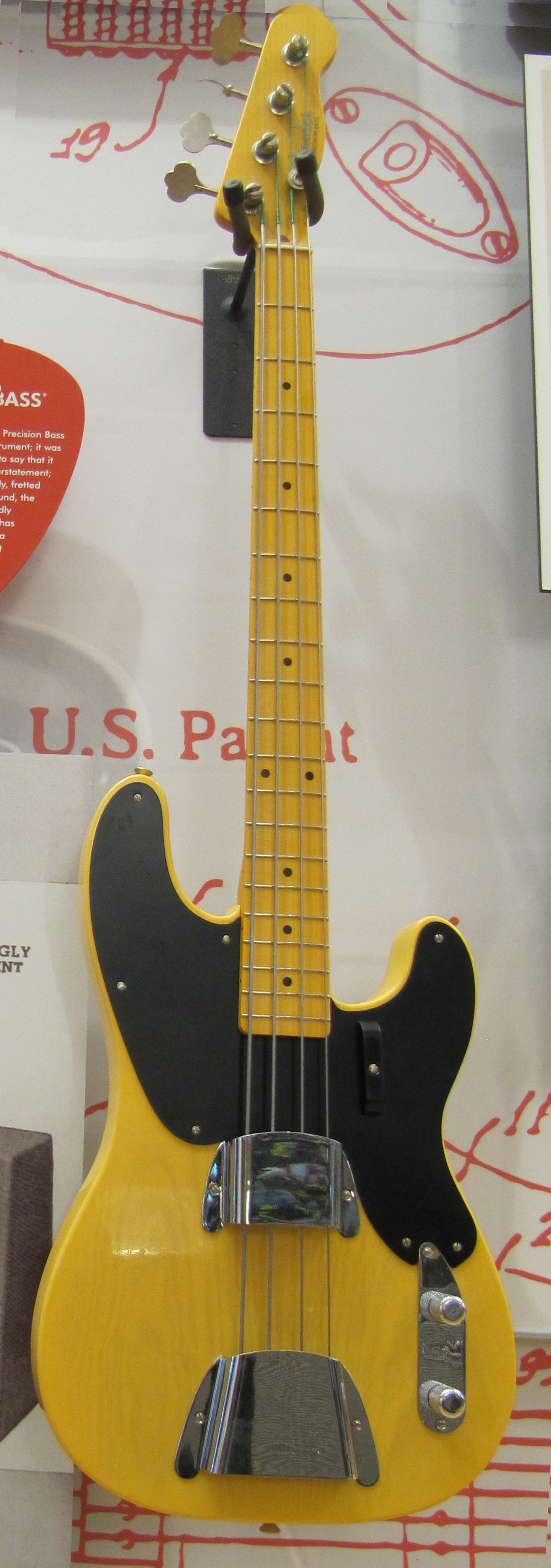

The Precision Bass was the first electric bass Fender put into commercial production, in October 1951. At the time, the upright bass was large, hard to transport, and easily lost inside a band's growing volume. Fender solved that problem differently with a new instrument.
Early models looked different from today's Precision Bass. A flat ash body, a Telecaster-style headstock, a single pickup, 20 frets, a 34-inch scale. After contours were added in 1954–55, the split-coil pickup and the basic shape that continues today settled into place in 1957.
What's interesting is that a ‘finished classic’ wasn't there from the start. It was revised as it was used, and the revised result became the standard in turn.
Fender still calls the Precision Bass a ‘go-to foundational instrument’ today. That's brand language, so it doesn't need to be taken as objective judgment as-is. But the fact that the same basic concept keeps appearing across price points and variations for decades shows that this design became a platform in its own right.
From the perspective of WHAT REMAINS, this is also why the Precision Bass is interesting. It didn't remain because it's old — it remained because the problems it has to solve, even when old, never went away. It has to be heard, has to play reliably, has to move together with other instruments. Above all, it has to not get in the music's way.
IT SURVIVES BY NOT GETTING IN THE WAY.
Why This
Instrument?
We think we're choosing an instrument's specs. But the longer we play, the more the instrument shapes our habits and choices too.
Before it's a device that makes sound, an instrument is an interface that meets the body. Neck thickness changes the path of the left hand; scale length changes the distance between notes. Body balance shapes how you stand; pickup position decides where the right hand rests.
That's why it's hard to sum up ‘a good instrument’ in one rating chart. Some instruments make fast phrases easy; others make you more conscious of the space between notes. Some let you relax your grip; others only sound right when you commit force to them.
This is close to why an old instrument keeps getting chosen again. A new instrument offering more features doesn't make a familiar one disappear. An instrument worn into the hand gives more than its specs. It's a bodily memory that lets you pick the next note without thinking.
The Precision Bass is a good example of this. According to Fender's official records, the first commercial Precision Bass was produced in October 1951, with a 34-inch scale and a single pickup. Body contours were added in 1954–55, and by 1957 the split-coil pickup and body/headstock shape we know today were in place. The key point is that its basic role stayed the same even as it changed.
An instrument's value isn't measured only by ‘how much it can do.’ Is there still a reason to pick it up again? Can the player make their own music clearer with it? And, even after time passes, does that choice still feel natural?
IS CHOOSING HOW YOU WANT TO MAKE MUSIC.
Hitsville
U.S.A.
Music history isn't made of songs alone. The rooms where people met and worked, again and again, are part of that history too.
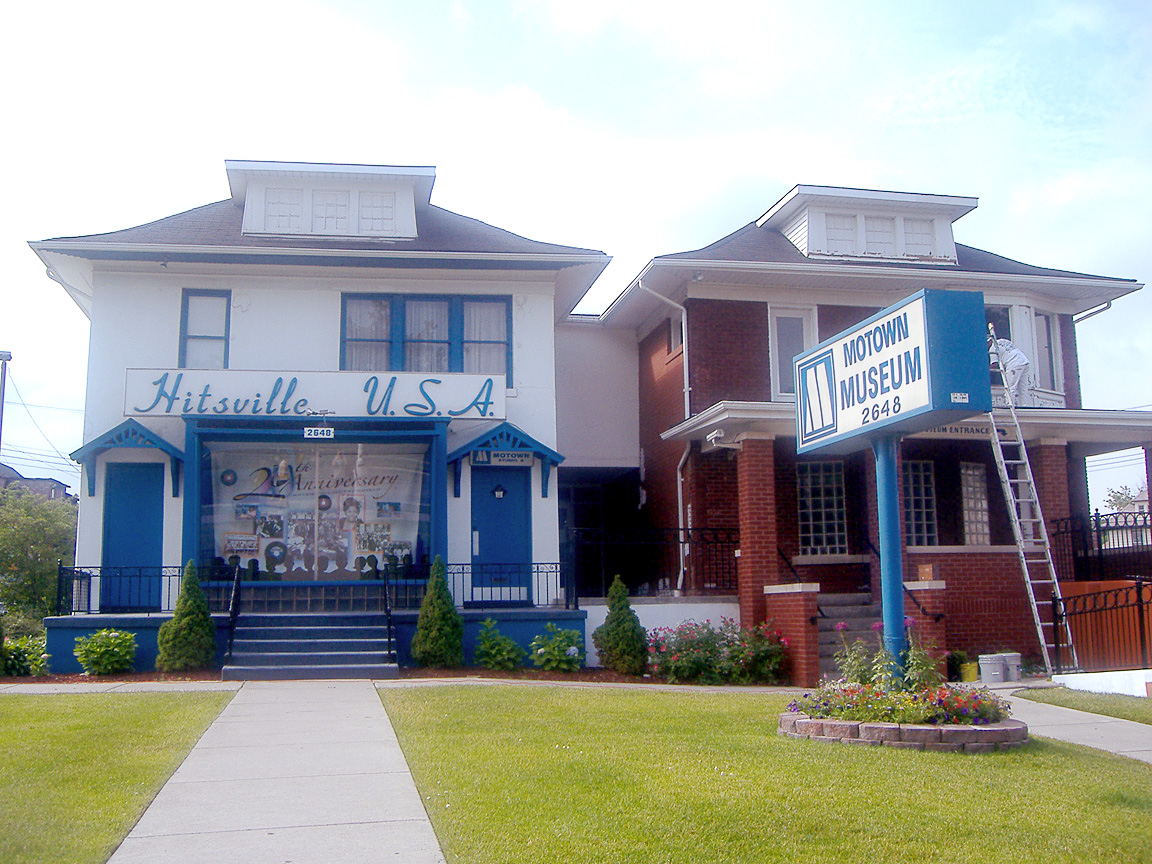
In 1959, Berry Gordy bought a two-story house at 2648 West Grand Boulevard in Detroit and turned the first floor into Motown's base, and that's how Hitsville U.S.A. began. A converted photo studio in the back became Studio A, and countless Motown recordings came out of that room.
Today the Motown Museum introduces this place as the ‘birthplace of the Motown Sound.’ Studio A still holds the instruments and recording gear of the time, and the Control Room still carries the traces of the original equipment and work.
What matters about Hitsville is less the romance of a ‘legendary room’ and more the fact that it was a working system. Songwriters, producers, engineers, session players, and vocalists moved within the same ecosystem. Motown Museum records also show that the session players of the time worked as an interconnected group, later remembered under the name Funk Brothers.
You don't need to look only at the equipment list when you look at a musical space. You have to look at how easily people gathered, how often they came back together, how quickly they understood each other's language. A good space changes the sound, but before that, it changes how people behave.
SOURCE — Motown Museum
EDITORIAL NOTE — The Motown Museum notes that, starting January 20, 2026, it has paused guided tours of Hitsville U.S.A. and is preparing to resume them in spring 2027. It's worth checking the official site again before visiting.
BECAUSE OF ITS WALLS. IT IS BECAUSE THE SAME PEOPLE
SOLVED THE SAME PROBLEMS THERE, AGAIN AND AGAIN.
Motown Museum
One Record:
What's Going On
Listen to one record five times. Instead of knowing more from the start, discover something different each time.
Marvin Gaye's What's Going On was released in 1971 and entered the U.S. Library of Congress's National Recording Registry in 2003. The Library of Congress essay describes it as an important recording where modern soul, social commentary, and musical craft meet.
Calling it a ‘classic’ isn't enough. What's more interesting is that it asked a different question from the success formula Motown was used to at the time. According to Library of Congress materials, amid the Vietnam War and social conflict and change, Gaye asked himself again what his music and his role were, and that questioning led to this album.
Jamerson's bass is one of this album's hearts. On most tracks, he used the combination of a Fender Precision, La Bella flatwounds, and an Ampeg B-15 to leave lines that were thick yet always moving. For the title track, accounts repeated in several places say that by the time Gaye brought him from a bar, he was already considerably drunk, and he ended up playing lying on the floor. That the line still lives even in that state quietly shows that ‘judgment’ comes before ‘technique.’
FIRST LISTEN — THE SONG
Follow only the lyrics and melody. Just feel where it tightens and where it releases.
SECOND LISTEN — THE RHYTHM
Listen to the relationship between drums and bass. Notice what repeats, and what changes just slightly.
THIRD LISTEN — THE SPACE
Listen to the empty spaces between the instruments. Music is made not only from the notes played, but from the space left open.
FOURTH LISTEN — THE TIME
Recall the questions of the era this music came from. But don't let the historical explanation replace the act of listening.
FIFTH LISTEN — YOUR MEMORY
On the last listen, set the explanations down. Write, in one sentence, ‘What stayed with me from this record?’
This approach isn't only for What's Going On. Any good record can be listened to five times again. What remains then isn't a review's conclusion, but your own experience of listening.
THEY ARE A WAY TO HEAR MORE.
Library of Congress
Things
We Keep.
What remains might not be something grand. What you pick up again. What you play again. What you go back to.
An instrument you keep using longer than your first one. The moment something worn into your hand becomes the best interface.
A good record leaves not one listening experience, but many discoveries.
A space where music was heard and made can sometimes be remembered longer than the sound itself.
Music,
well considered.
THE STANDARD GROOVE aims to be easy to enter — and still worth rereading for anyone who has spent years with the instrument.