One SongJoshua Redman — Jazz Crimes
Joshua Redman, Elastic (2002).
I had a student who slapped like Flea, with the thumb pointing down. On stage he wore the strap long and low. That posture was not bad at all. It brought out his own style.
But the student wanted to change it. The seniors and juniors from his club band kept asking why he played like that, and told him it was wrong. What he wanted was the usual posture — something like Marcus Miller's.
I did not think it needed fixing. MonoNeon plays his bass upside down, and there is nothing wrong with it.
Through high school and university I met countless players, and I never saw two people play with the same posture.
Carol Kaye played with a pick. Flea has a very unusual slap posture.
And yet both of them play beautifully, and both sound great.
Nobody needs Marcus Miller's posture, and there is no reason to have it. If you want it for yourself, then go ahead.
Each player makes their own sound with their own posture, and that is what gives a player character.
If the sound you want is coming out well, the first goal is already met.
Of course, playing does not end with sound. Performance and movement matter enormously too.
So I recommended not bothering to change it. There is no reason to change a posture that is already well set, and fixing it can be several times harder.
That posture is not the usual one, but it could become his character — a huge strength.
Though, of course, there may be more times when he has to explain to people why he plays that way.
Still, the student wanted to change. So we fixed the strap length first, and practiced again from scratch, calmly, with a metronome.
In fast songs or demanding passages, the old posture kept trying to creep back. But in the end he corrected it well, and his sound changed too. He now had two options for slapping — so he could pick one to suit the situation.
After the change, the student said, 'Did I really have to do this?'
He did not have to, honestly. But since he had already changed it, I told him to use each one as the situation calls for.
If the player wants to change, change. But there is no need to.
I have changed my posture too. Listening to Marcus Miller's thumb, I wanted to copy how that sound came out.
For fingerstyle, I watched Matthew Garrison's posture and chased his tone. I even switched instruments for it.
I loved having more options that way.
I did not change because someone said I was wrong. I changed because there was a sound I wanted.
That is why, before I talk about posture, I ask first: what sound do you want to make?
Knowing what sound you want is not something you learn; it grows from listening. People who have listened a lot have natural posture and a natural sound. They followed the sound in their head, and their body found the position on its own.
Posture is not a matter of angles or positions. It is a matter of sound and feel.
The posture you learn when you first ride a bicycle stays with you for life. Bass is the same. I have seen so many cases where the feel formed at the very beginning simply hardens in place.
In the first lesson I check exactly two things.
How the right hand feels when it touches the string: where and how the finger catches as it plucks.
How the left hand feels when it touches the fingerboard: with one finger as the reference, what pressing feels like.
This is not about learning technique. It is about remembering a sensation. That feeling becomes the reference point.
In the second week, I have them find that same sensation with other fingers and in other positions. The feel of pressing with the index finger, now with the ring finger; what they felt at the first fret, now at the seventh. This is where steadiness comes from.
A beginner's playing wobbles not because their fingers are weak, but because the feel is different in every position, and they are searching for it again every time.
So if you plan to take lessons, I suggest the first four or so without an instrument of your own.
If there is a bass at home, you will try all sorts of things on it — even more so because this is the period when you play the most, with the most enthusiasm. But if you play alone for hours before you know what the reference is, the wrong feel gets lodged in your body as it is.
That is also why the student I mentioned kept slipping back into his old posture in fast songs. The feel that settles into your body first is that strong.
We meet once a week. One session cannot undo what hardened over the whole week. And by the next week, it has hardened that much again.
What you need to build in the first month is not skill but feel. That is far harder to fix later.
Posture is free. But there is one standard: where does it hurt?
If the tips of your right-hand fingers do not hurt at all, you are touching the strings too gently. That is a place that should hurt.
If your wrist or shoulder hurts, that is not something to endure. Those are places that must not hurt.
When these two get reversed, habits grow that have nothing to do with sound. This is usually why someone practices hard and the sound still does not improve.
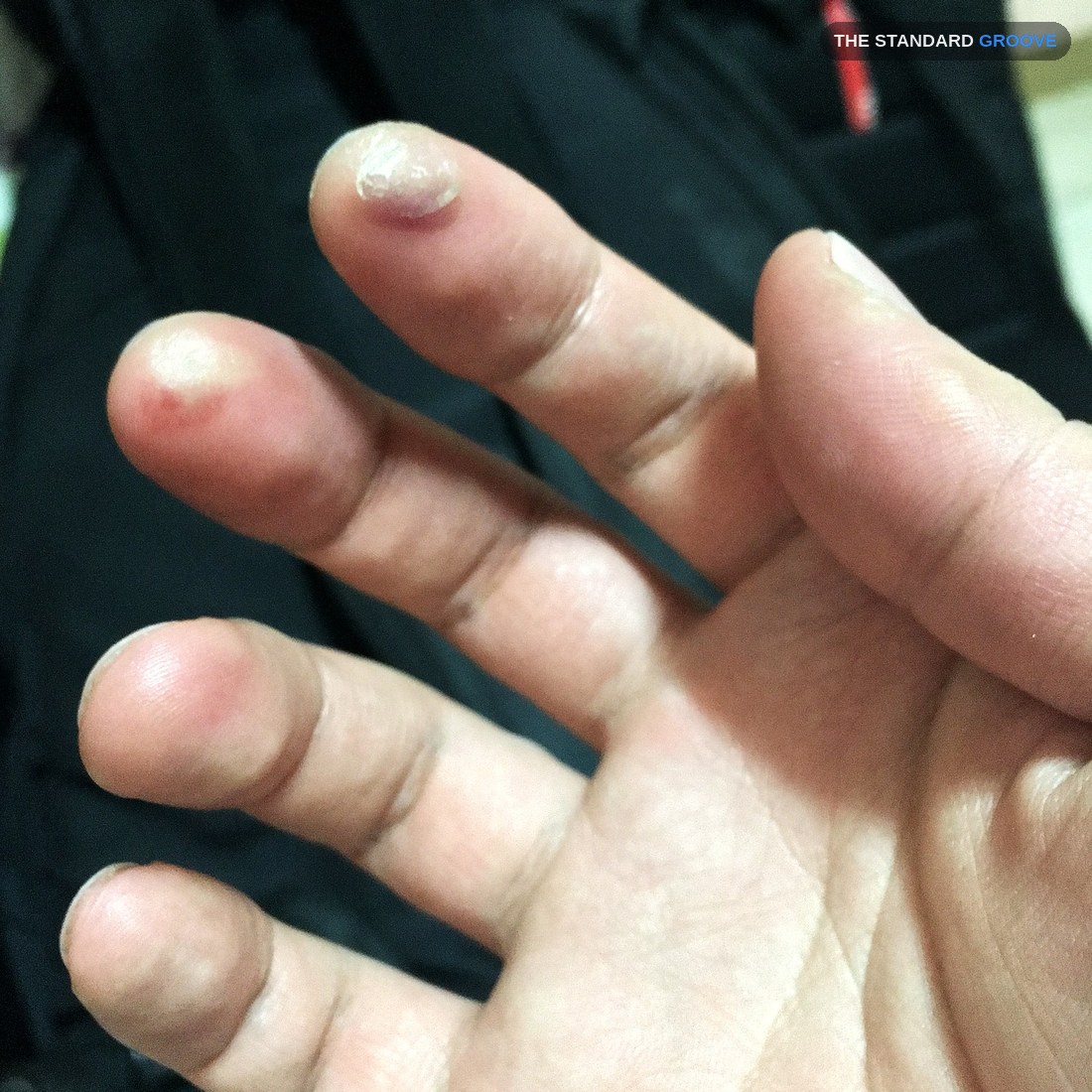
As far as I remember, my wrist or shoulder has never hurt. What hurt were the right-hand fingers that touch the strings directly — back when I played extremely hard because I wanted to sound like Rocco Prestia and Paul Jackson.
Many of my bassist friends have struggled with tendinitis in the wrist. Not so much because their posture was wrong, but because as professionals they played so much that it became too much.
This is the problem I see most often in people who come to lessons after teaching themselves. They practice a lot, but they are either enduring pain where it must not hurt, or playing around the place that should hurt so that it does not.
At first, the fingertips of your right hand hurt. If you played enough for it to hurt, you deserve credit. And that is when you should rest.
When it is fun, you do not even think of stopping, sore fingers or not. But when the thought 'it hurts, maybe I should rest' comes up, that is the time to rest. Even students preparing for entrance exams take a break then.
The places that should hurt should hurt, and the places that must not hurt must not.
For students preparing for applied-music entrance exams, the practical exam carries a lot of weight. And once they get into university, they end up accompanying entrance auditions a lot, almost like a part-time job.
Drum and guitar audition pieces are full of fast, complex passages and changing meters.
While rehearsing together, some players never quite lock in. Their breathing feels different every time they play.
When I checked, many of them were holding their breath at a particular fill.
That was when I first realized it. I was holding my breath too.
So I calmly sorted out the rhythm, and matched the beat I was counting inside with the breathing of my playing hands.
When you lift a heavy dumbbell, you hold your breath. Playing is the same.
When a hard passage comes, you hold your breath without noticing, and your whole body stiffens. Trying to relax only your hands will not loosen it.
Since then, wherever I am, whenever the rhythm will not sit, I first check whether someone is holding their breath.
I also find it hard to agree with 'my hands are too small to play'. Many people with small hands play very well. In most cases the trouble is not that they are small, but that the tension has not let go. And when the tension will not let go, the cause is usually somewhere else.
There is no right posture. But whether I am breathing — that, I can check at any time.
This is what self-taught players worry about most: what if my posture goes wrong while I practice alone?
My answer comes with a condition. If you know what sound you want, and you know where it must not hurt, you do not need to worry.
If you know neither, it is a different story. Months of playing alone without a reference, and habits unrelated to sound harden while you push on with pain where it must not hurt. In that case the worry about posture is not excessive; it is fair. You need someone to take one look.
Saying there is no right posture does not mean you can play any way at all. It means: look at sound and feel instead of angles, and at where it hurts instead of the shape.
The answer is sound, not angles. Looking in the mirror to remember the feel of when you got the sound you want — that is good. But looking in the mirror to copy a posture you have seen? That seems like a hard way in.
The right posture is not a famous player's posture. It is the one that lets you make the sound you want.